
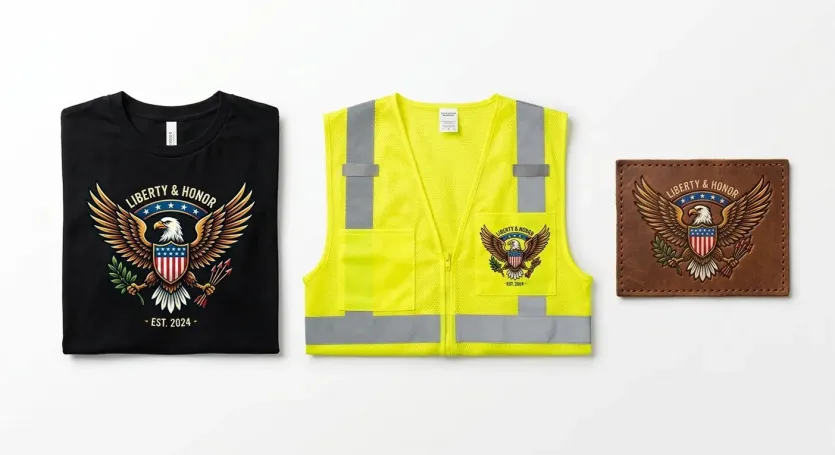
DTF stands for Direct to Film. In DTF printing, a design is printed onto a PET (polyethylene terephthalate) film using water-based pigment inks, coated with a hot-melt adhesive powder, cured with heat, and then transferred onto fabric using a heat press. The result is a full-color, flexible print that bonds to the fabric surface without requiring pretreatment, or fabric-specific inks.
This guide explains the DTF process step by step, how it behaves on different fabric types, how durable it is through washing, and when it is the right method versus screen printing or DTG printing.
What Is DTF Printing?
DTF printing is a garment decoration method where the design is produced on a transfer film first, then applied to the garment with a heat press. Unlike screen printing — which pushes ink through a mesh stencil directly onto fabric — or DTG printing — which sprays ink directly into fabric fibers — DTF keeps the ink on a film until the moment of transfer.
This separation between printing and application gives DTF one defining advantage: it works on virtually any fabric that can withstand heat press temperatures. Cotton, polyester, poly-cotton blends, nylon, fleece, denim, leather, and performance fabrics all accept DTF transfers effectively.
The printed film is transferred onto the desired material using heat and pressure. This method works on cotton, polyester, blends, and even darker fabrics, making it more versatile than some other print technologies. Unlike Direct to Garment printing, DTF does not require pre-treatment of fabric.
The DTF Printing Process: Step by Step
Step 1: Design Preparation
The design is created or prepared in standard graphic software like Adobe Illustrator, Photoshop, or CorelDraw, and exported as a PNG file with a transparent background. The file is then mirrored horizontally before printing. The mirror matters: the design prints face-down onto the film, and when transferred, it flips to face the correct direction on the garment.
Unlike screen printing, which requires the artwork to be separated into individual color layers, DTF prints the full design in CMYK digital color. Gradients, photographic images, multi-color logos, and fine detail all print in a single pass without the per-color setup cost that screen printing requires.
Step 2: Printing onto PET Film
The mirrored design is printed onto a PET film using a DTF-compatible inkjet printer loaded with water-based pigment inks. The printer deposits CMYK color layers first, then lays a white ink layer over the entire printed area. This white ink layer is the opacity foundation — it is what allows colors to appear vibrant on dark-colored garments without the fabric dye underneath bleeding through.
DTF relies on PET films with a special coating to accept ink and release it during heat pressing. Films are available in sheets or rolls, and the coating helps the design transfer cleanly without leaving residue on the garment.
PET film thickness in standard commercial DTF production is 0.5–1mm. Thinner films transfer more cleanly and produce a softer hand feel on the finished garment.
Step 3: Applying the Adhesive Powder
While the ink is still wet on the film, a hot-melt adhesive powder is applied evenly across the printed area. Excess powder is shaken off. The adhesive is thermoplastic polyurethane (TPU) — a flexible polymer that, when melted and re-solidified, creates a rubber-like bond between the ink layer and the fabric fiber.
This is the chemistry that makes DTF prints flexible rather than rigid. TPU does not become brittle when it cures. It remains elastic, which is why DTF prints flex with stretchy fabrics rather than cracking the way a thick screen print can on a stretch polyester blend.
The durability of DTF printing is rooted in its unique process and the chemistry of its components. The process involves printing a design with specialized water-based pigment inks onto a PET film, then applying a thermoplastic polyurethane (TPU) adhesive powder to the wet ink.
Step 4: Curing the Adhesive
The powder-coated film is passed through a curing oven or placed under a heat press at a low temperature — approximately 250°F — for a controlled time. This melts the TPU adhesive into the ink layer without fully activating the transfer. The result is a cured transfer that is stable, ready to handle, and can be stored before application.
Step 5: Transferring to Fabric
The cured film is placed face-down on the garment, with the print surface contacting the fabric. The heat press closes at the correct settings:
- Temperature: 300–325°F (150–165°C)
- Time: 10–15 seconds
- Pressure: 40–60 PSI
These three parameters work together. Temperature melts the TPU adhesive. Time allows the adhesive to fully penetrate the fabric surface. Pressure forces the adhesive into the fabric’s weave or fiber structure, creating the mechanical bond that holds the print through repeated washing.

The pressure setting is the most commonly miscalibrated parameter. Applying less than 40 PSI results in incomplete adhesion at the edges of the design — which is the root cause of edge lifting after washing. The edges lift first because they receive the least pressure relative to the center of the design. Correct pressure prevents this.
Step 6: Peeling the Film
After pressing, the PET film is peeled away from the garment, leaving the design bonded to the fabric surface. Peeling method depends on film type:
Hot peel: Film is removed immediately after pressing. Hot peel produces a softer, matte hand feel on the finished print. This is the standard for apparel garments where a soft feel is preferred.
Cold peel: Film is removed after a 5–10 second cooling period. Cold peel produces a slightly stiffer feel and a subtle gloss finish. This is used primarily for hard good applications — promotional products, mugs, signage — where a glossier surface is the desired outcome.
Step 7: Re-Press
After peeling, the garment is re-pressed for 5–10 seconds under a cover sheet. This final press seals any edges that may not have fully bonded, improves adhesion uniformity, and gives the print a finished, smooth surface. Skipping the re-press is a common shortcut that reduces wash durability, particularly at print edges.
How DTF Behaves on Different Fabric Types
Cotton
100% cotton is the most compatible fabric for DTF printing. The tight, stable weave of woven cotton and the consistent fiber structure of knit cotton both accept the TPU adhesive cleanly. Color vibrancy is high, adhesion is strong, and wash durability reaches the upper end of the 50–100 wash range with proper care.
Polyester and Synthetic Fabrics
This is where DTF separates itself from DTG and screen printing most clearly. DTF works on nearly every heat-pressable material: cotton, polyester, fleece, nylon, and blends. DTF printing is suitable for a wide range of fabric types, including synthetic fabrics and synthetic materials, making it highly versatile for both natural and synthetic textiles. DTG, however, performs best on 100% cotton or high-cotton blends, as these materials absorb the ink effectively.

Polyester fabrics repel water-based inks because the synthetic fiber does not absorb moisture. This makes DTG perform poorly on polyester — the ink sits on the surface with weak adhesion. DTF avoids this problem entirely because the ink never needs to absorb into the fiber. The TPU adhesive creates a surface bond that holds regardless of fiber type.
For Washington construction crews and HVAC technicians wearing moisture-wicking polyester hi-vis shirts, this is the practical difference: DTG on polyester hi-vis produces faded, poorly bonded prints. DTF on the same shirt produces a clean, durable result. See custom hi-vis safety shirts for Washington construction crews on polyester fabric for application examples.
Poly-Cotton Blends
50/50 cotton-polyester and 65/35 cotton-polyester blends, the fabric of most work shirts, hoodies, and performance garments accept DTF well across both fiber ratios. The TPU adhesive bonds to both fiber types within the blend, producing consistent adhesion across the print area.
Cotton-poly blends can print well, but often require DTF or screen printing for long-term results. Pure polyester typically resists water-based inks and demands special approaches like sublimation or DTF.
Performance and Technical Fabrics
Moisture-wicking polyester, mesh, and technical performance fabrics used in athletic wear and hi-vis safety apparel are compatible with DTF. The key variable is pile height — flat woven or fine knit surfaces produce sharper, more durable DTF prints than high-pile surfaces like heavy terry or long-pile fleece, where the adhesive contacts fiber tips rather than the fabric body.
Highly Elastic Fabrics
Spandex and high-stretch blends (more than 20% elastane) present a challenge for DTF. The TPU layer is flexible, but extreme stretch — 50% or more — can eventually cause micro-cracks in the adhesive layer after repeated washing. For high-stretch garments, DTG or screen printing with water-based ink on cotton are better long-term choices.
DTF Wash Durability: What the Numbers Actually Mean
A quality DTF print can typically withstand 50 to 100 wash cycles without significant fading, cracking, or peeling. This level of durability often surpasses other digital printing methods like Direct-to-Garment printing, especially on darker fabrics.
The 50–100 wash range is real but wide. The actual number for any specific print depends on four factors:
1. Press parameters. Correct temperature (300–325°F), time (10–15 seconds), and pressure (40–60 PSI) are the primary determinant of wash durability. Under-pressed transfers begin failing at 20–30 washes. Correctly pressed transfers reach 75–100 washes routinely.
2. Re-press completion. The final 5–10 second re-press after peeling significantly extends edge durability. Prints without re-pressing fail at the edges first.
3. Fabric type. Cotton and poly-cotton blends produce the highest wash durability. High-stretch fabrics and very loosely woven substrates produce the lowest.
4. Wash care. Turn garments inside out before washing, use cold water on a gentle cycle, and tumble dry on low or hang to dry. Avoid bleach and fabric softeners, as they can degrade the print’s adhesive over time.
For comparison: Screen printing typically outlasts DTF, resisting fading, cracking, and peeling for 50–100 washes or more. DTF performs well for 20–50 washes with good care, but can show wear and edge lifting sooner, especially on high-friction areas. This is accurate for plastisol screen printing on cotton. Washington businesses ordering 24 or more pieces on cotton garments with a simple logo will typically find screen printing the better long-term value — see custom screen printing services in Washington state for bulk pricing and turnaround details. On polyester and blended fabrics where screen printing is less reliable, DTF’s advantage in durability is clearer.
DTF vs DTG vs Screen Printing vs HTV: The Full Comparison
Many buyers confuse DTF with heat transfer vinyl (HTV) or assume it is the same as DTG. These are 4 distinct methods with different production processes, cost structures, and use cases.
| Variable | DTF | DTG | Screen Printing | HTV (Heat Transfer Vinyl) |
|---|---|---|---|---|
| Fabric compatibility | Cotton, poly, blends, nylon, leather | 100% cotton best; poor on polyester | Cotton, poly (plastisol); blends | Cotton, poly, blends (simple shapes only) |
| Minimum order | 24 Pieces | 12 Pieces | 48 pieces | 24 Pieces |
| Design complexity | Unlimited colors, gradients, photos | Unlimited colors, gradients, photos | 1–8 colors per setup | Single color per layer; no gradients |
| Setup cost per design | $0 | $0 | $25–$45 per color per screen | $0 (cutting only) |
| Per-piece cost (small run) | $10–$25 | $15–$30 | Not viable under 12 pieces | $8–$20 |
| Wash durability | 50–100 washes (correct press) | 40–50 washes (cotton) | 50–100+ washes (plastisol) | 50–75 washes |
| Hand feel | Slight texture, flexible, smooth matte | Soft, fabric-like, no texture | Slight texture (ink sits on fabric) | Thick, stiff (layered vinyl) |
| Dark garment performance | Excellent (white ink layer built in) | Good (pretreatment required) | Excellent (opaque plastisol) | Good (vinyl covers background) |
| Pretreatment required | No | Yes (dark garments) | No | No |
The clearest distinction is between DTF and HTV. Both use a heat press. Both work with 24 minimum order. But HTV requires cutting and weeding each design element from vinyl sheets — a manual process that limits designs to simple shapes and single colors per layer. DTF prints the full design digitally onto film and transfers it in one press, with unlimited colors, gradients, and photographic detail.
For buyers whose order exceeds 24 pieces with a simple 1–4 color logo, screen printing becomes the more cost-efficient option — see screen printing minimum order quantities and setup costs explained for the full per-piece cost breakdown.
For a full comparison of DTF, DTG, and screen printing across more buyer scenarios, see DTG vs DTF vs screen printing – full comparison for Washington buyers.
When DTF Is the Right Method for Your Order
DTF is the right decoration method when:
Your garment is polyester or a poly-cotton blend. This is the most important use case. If your order is on polyester performance shirts, moisture-wicking hi-vis shirts, athletic wear, or any synthetic fabric, DTF produces clean, durable results where DTG fails and where screen printing requires careful ink selection.
You need fewer than 48 pieces. Screen printing setup cost makes small orders expensive. DTF has 24 minimum per design, which makes it the better economics at low quantities with complex artwork. For orders where your garment is 100% cotton and the design is photographic or full-color, DTG is the comparable low minimum alternative of 12 pieces — see DTG printing for small orders under 24 pieces to compare which fits your fabric and artwork.
Your design has unlimited colors, gradients, or photographic detail. A 12-color logo, a photographic image of a machine, or a design with gradient shadows all print in a single DTF pass at the same cost as a 2-color design.
You need different designs on each piece. Gang sheet printing allows multiple designs to be nested on a single film sheet. Each design in the gang prints simultaneously, reducing per-design film cost. A buyer ordering 3 shirts with 3 different designs pays one film cost, not three.
You need a small addition to an existing order. A Washington construction company with an established screen printing order for 50 shirts may need 5 additional shirts for a new supervisor with a slightly different logo version. DTF handles the 5-piece addition with no screen setup cost.
For DTF printing services in Washington state with 24 minimum orders, contact NW Custom Apparel at 1-800-851-3671 or sales@nwcustomapparel.com.
Frequently Asked Questions
DTF printing works in five steps: design is printed onto PET film using CMYK and white pigment inks; hot-melt TPU adhesive powder is applied while ink is wet; film is cured with heat to bond adhesive to ink; film is heat-pressed onto fabric at 300–325°F for 10–15 seconds at 40–60 PSI; film is peeled away leaving the bonded design on the garment.
Yes. DTF prints reliably on 100% polyester, poly-cotton blends, and synthetic performance fabrics. This is DTF’s primary advantage over DTG, which performs poorly on polyester because the water-based ink cannot bond to synthetic fibers. DTF’s TPU adhesive creates a surface bond that works on all heat-pressable fabric types.
A properly pressed DTF print typically lasts 50–100 wash cycles. Wash durability depends on correct press parameters (300–325°F, 10–15 seconds, 40–60 PSI), completion of the re-press step after peeling, and wash care (cold water, inside-out, no bleach, tumble dry low).
HTV (heat transfer vinyl) requires manually cutting and weeding individual design elements from solid-color vinyl sheets. It is limited to simple shapes and single colors per layer. DTF prints full-color designs digitally onto film with unlimited colors and gradients, then transfers the whole design in one press. DTF handles complexity that HTV cannot.
Edge lifting is caused by insufficient press pressure — typically below 40 PSI. The edges of the design receive the least pressure relative to the center, and if pressure is too low, the TPU adhesive does not fully bond at the perimeter. Correct pressure (40–60 PSI) and completing the re-press step after peeling both prevent edge lifting.
For most fabric types, yes. DTF’s heat-bonded TPU adhesive creates a more consistent surface bond than DTG’s water-based ink absorption, especially on polyester and blended fabrics where DTG ink adhesion is weaker. On 100% cotton, DTG and DTF durability are comparable.
No. DTF does not require fabric pretreatment of any kind. The white ink layer provides opacity on dark garments without a separate pretreatment step, which reduces production time compared to DTG.
A gang sheet is a single PET film sheet with multiple different designs printed and nested together. Ordering a gang sheet rather than individual film sheets for each design reduces the per-design film cost, making DTF more economical for buyers ordering small quantities of multiple different designs.
DTF Printing at NW Custom Apparel in Washington State
NW Custom Apparel offers DTF printing in Washington state with 24 pieces minimum order and standard turnaround of 10 days on qualifying orders. However, we charge under-minimum fee of $50 for order below 24 pieces. DTF is particularly suited for Washington construction crews and HVAC companies ordering branded logos on polyester hi-vis shirts, moisture-wicking work shirts, or performance fabrics where DTG would fail and screen printing minimums are not met.
For all DTF printing services including garment compatibility, file requirements, and pricing, see DTF printing services in Washington state.


