
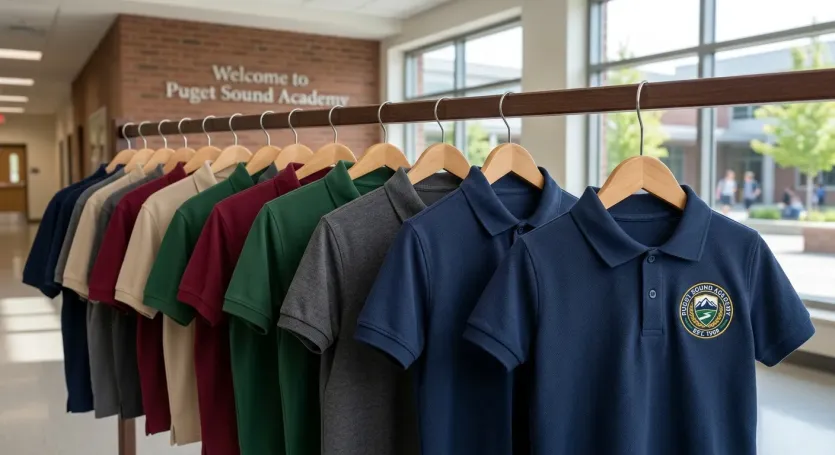
Most school uniform meetings start with the polo. It is the right call for many schools, but only when you specify it well. This guide shows you how to choose school uniform polo shirts by fabric, sizing, fit, colors and logo placement. Get those right and your bulk order looks the same on every student.
Not sure which spec fits your dress code? Talk with our team about your school’s options.
Quick answer: what type of polo is best for a school uniform? A cotton/polyester pique polo is a practical default for everyday K-12 wear. It balances comfort, structure, durability and easy care. Performance polyester suits active students and warm classrooms. Your dress code, budget and climate make the final call.
Why do schools choose polo shirts for school uniforms?
A polo sits in a spot no other garment reaches. It is more structured than a T-shirt and easier to wear than a button-down. Families keep it clean without special care.
Polos balance comfort and a polished look

A plain T-shirt is comfortable but reads casual. A button-down looks sharp but moves stiffly through a full school day. The polo lands in the middle. The collar and placket add structure, and the knit fabric moves like a T-shirt. Students look put together without fighting their shirt at recess.
Polos fit school routines and family laundry
Knit fabric flexes during PE warm-ups, assemblies and recess. Most polos are machine washable, and many cotton/polyester blends need little ironing. Families get a uniform they keep ready for Monday morning. Fabric weight and blend decide how long a polo lasts, not the polo style alone.
Polo shirt vs. T-shirt vs. button-down
Polo Shirt Comparison for School Uniforms
| Feature | Polo | T-Shirt | Button-Down |
|---|---|---|---|
| Polished appearance | High | Low to medium | High |
| Comfort for full-day wear | High | High | Medium |
| Ease of movement | High | High | Medium |
| Ease of care | High | High | Medium |
| Uniform consistency | High | Medium | High |
A polo does not win every row. It never scores low, which is harder for a T-shirt or a button-down to claim.
How to choose school uniform polo shirts: 7 decisions before you order
A bulk order goes wrong when one decision stays open. Settle these seven items first, and your quote, sample and final order line up.
Start with your dress code and state rules
Your school’s dress code comes first. Colors, collar style and logo rules vary from school to school. Washington state law lets district boards require uniforms in the schools or programs they set up. The same statute tells districts to accommodate students so the requirement does not become an unfair barrier to attending school. Keep that in mind when you set quantities, size ranges and budget.
The seven specs every bulk order needs
Here are the seven decisions, in the order most schools make them:
- Choose the garment style. Pick short sleeve, long sleeve or both.
- Choose the fabric. Compare cotton/polyester blend, pique and performance.
- Set the colors. Match the dress code and approved school colors.
- Build the sizing plan. List youth, adult and staff ranges.
- Define the logo. Set size, placement and thread colors.
- Approve a sample. Review a physical piece before production.
- Plan the reorder. Decide how next year’s order will match this year’s.
The sections below walk through each one.
Who needs to sign off
Uniform decisions rarely sit with one person. Administrators set policy, PTA or booster groups raise money, and parents pay. Share the seven-spec list with each group before you request a quote. Late changes after a sample ships cost the most time.
Which polo fabric is best for school uniforms?
No single fabric fits every school. Your dress code, budget and climate decide. This table shows how the four common school choices compare.
Cotton, cotton/polyester blend, pique and performance compared
School Uniform Polo Fabric Comparison
| Fabric | Best fit | Strength | Watch-out |
|---|---|---|---|
| Cotton | Comfort-first programs | Soft feel | Wrinkles and shrinks more |
| Cotton/polyester blend | Everyday K-12 wear | Tends to hold shape and color | Less natural feel |
| Pique (cotton or blend) | Traditional uniform look | Structured, textured surface | Heavier texture |
| Performance polyester | Active days, warm rooms | Moisture management | Less traditional look |
Cotton/polyester blends are the most common starting point for a cotton blend school polo. They balance comfort and easy care for daily wear.
Pique vs. performance polo for schools
Pique is a textured knit with a small cellular pattern. The cotton industry fabric guide notes it appears most often in polo shirts. That structure gives the classic look many dress codes picture.
Performance polyester pulls moisture away from the skin. It helps in warm classrooms and on gym days. The tradeoff is a look that reads more athletic than traditional.
How fabric choice affects durability
Fabric weight, blend and collar construction decide how long a polo lasts. Check the collar, placket and hem stitching first, since those areas wear out earliest. We do not publish wash-count promises for school polos. Results depend on the exact garment you buy.
Want a deeper fabric breakdown for embroidered orders? Read our polo fabric comparison for embroidered orders. For logo stitching on different garments, see which fabrics hold embroidery best.
How should schools size youth, adult and staff polos?
Sizing causes more uniform problems than any other spec. A little planning here saves reorders later.
Why youth and adult sizing cause mismatches
Size charts differ by brand and by cut. A youth large in one brand does not match a youth large in another. Mixed brands make the same uniform look different on picture day. Pick one garment style and one size chart for the whole program.

Fit and growth room
Leave room to grow without a loose, sloppy look. An oversized polo sits badly at the collar and shoulders. Test the sample on real students of different ages before you approve it.
Collect sizes and plan a buffer
Collect sizes by grade, then add a buffer for late enrollees. Here is a planning example, not a client order:
- A school has 300 students and 25 staff
- Add a 10% buffer on student polos: 300 x 0.10 = 30 extra
- Total order: 300 + 30 + 25 = 355 polos, split by size afterward
Your decorator should help set the size split. We build school orders around the real mix, from youth through adult and staff.
Choosing the right polo is the first step. If your school needs youth and adult sizing, approved colors, logo embroidery and repeat ordering, see our custom school uniform polo shirt service. It covers garment options, embroidery details, sample approval and school-order support.
Staff and faculty sizing
Teachers, coaches and administrators need adult sizing, often in a different cut. Order staff polos from the same design file so the school looks consistent. For premium staff polos outside a student program, review our staff and faculty polo options.
Ready to turn a spec list into a school order? Send us your school colors, logo and rough size counts, and we will reply within one business day.
School uniform colors and polo logo placement
Colors and logo rules come from your dress code. Settle both before you request artwork or a sample.
Match colors to your dress code
Every school sets its own approved colors. Do not assume a standard school uniform color exists across Washington. Confirm garment colors and thread colors against your dress code and your school artwork.
Where the school logo goes
The left chest is the usual spot for a school logo on a polo. Your dress code sets the final rule on size and placement. Keep the logo size consistent across the program, or scale it by size range if policy allows.
How embroidery turns a logo into a stitch file
Embroidery sews the logo into the fabric, which is why many schools choose it for uniforms. Every logo is digitized first. Digitizing turns artwork into a stitch file that tells the machine how to sew. Send a clean, high-resolution file and your thread colors. Our artwork services team steps in when a school only has a low-quality copy.
Once you know which polo fabric and fit work for your students, the next decision is how the school logo gets applied. Our embroidered school uniform polo program covers logo digitizing, thread colors, placement, physical sample approval and repeat orders. For the full production picture, see our custom embroidery services and school logo embroidery pages.
Short Sleeve Vs. Long Sleeve School Polos
Sleeve length is a small decision with a big effect on your uniform list. Think about your climate and your gym schedule.
Short sleeve polos
Short sleeve suits warm months and gym-heavy days. It keeps students cool through the first and last weeks of the school year.
Long sleeve polos
Long sleeve adds a layer for cool, damp Puget Sound mornings in fall and spring. It replaces a separate top under a sweatshirt or cardigan. Ordering both sleeve lengths keeps the uniform list simple for families.
How to care for school uniform polos
Good care extends the life of any polo. Families follow simple steps best when you hand them over with the uniform list.
A simple care routine for families
Send these steps home with your uniform list:
- Turn polos inside out before washing
- Use cold or warm water with mild detergent
- Skip high heat in the dryer
- Remove polos promptly to cut down on wrinkles
Signs a polo is wearing out
Check polos at mid-year and at reorder time. Look for these signs:
- Curling or stretched collars
- Loose stitching on the placket or hem
- Uneven color fade
- Puckering around the embroidery
Approve A Physical Sample Before the Full School Order
A sample is the cheapest insurance in a bulk order. It shows you the real garment before hundreds of students wear it.
What to Check on the Sample
Review the sample on a youth and an adult. Check these points in daylight and indoor light:
- Garment color against your school colors
- Collar and placket stitching
- Fit across sizes
- Logo size and placement
- Thread colors against the approved artwork
Why a Screen Proof is not enough
Every monitor shows color differently. A physical piece shows true fabric color, embroidery scale and thread shade. That step catches problems before they reach hundreds of students instead of after.
“Their embroidery done in-house is very well done, identical to the proof of concept.”
Wyatt Smith, Google review of NW Custom Apparel
Keep your approved spec for next year
Write down the garment style, size chart, thread colors and logo placement. We keep your design file, thread colors and sizing history on record. Your school keeps the decision record, so next year’s reorder matches this year’s. We produce every school order in-house in Milton, Washington. See our in-house production process, and know we serve schools across Puget Sound, including Tacoma, Puyallup and Seattle.
When A Polo Shirt is not the Right School Garment
A polo is not automatically right for every school. Three situations call for a different plan.
Your dress code requires a button-down
Some policies require a collared, buttoned dress shirt. Follow the policy. A polo should never force a school away from its own rules.
Athletic programs need team uniforms
A polo is a school-day garment, not a game jersey. If your school needs jerseys, warm-ups or player names and numbers, see our custom team uniforms for schools and sports programs. Game gear lives in our jerseys and warm-ups service.
Spirit wear and parent ordering
Parents often want spirit wear outside the daily uniform. A school fundraising online store gives families one place to order approved apparel without paper forms. Schools also raise money with embroidered caps for school fundraising.
Ready To Specify Your School Uniform Polos?
Get your school uniform quote in one business day. Send your school colors, logo and approximate size breakdown, and we will recommend a garment that fits your dress code. Curious how embroidery pricing works first? Read what affects a custom apparel quote.
Request a Free School Uniform Quote →
Frequently Asked Questions
A cotton/polyester pique polo is a practical default for everyday school wear. It balances comfort, structure, durability and easy care. Performance polyester suits active students and warm classrooms. Your dress code, budget and climate decide the final choice. Use the fabric table in this guide to compare them.
Yes, polo shirts work well for most K-12 uniform programs. The collar and placket look polished, and the knit fabric moves comfortably through recess, PE and long school days. Families wash them in a normal laundry routine. A polo is not the right fit for every school, so check your dress code first.
Cotton/polyester blends and pique knits are the most common school choices. Blends tend to hold shape and color through frequent washing. Pique gives the traditional textured look. Performance polyester works for active days and warm rooms. For a full breakdown, see our polo fabric comparison for embroidered orders.
Use one garment style and one size chart for the whole program. Size charts differ between brands, so mixed brands make the same uniform fit differently. List youth, adult and staff ranges separately, add a buffer for late enrollees and check the sample on real students. Leave room to grow without a loose look.
Ordering both sleeve lengths is a common approach. Short sleeve suits warm months and gym-heavy days. Long sleeve adds a layer for cool, damp Puget Sound mornings without a separate top. One polo style in two sleeve lengths keeps the uniform list simple for families.
It depends on fabric weight, blend, construction and care. We do not promise wash counts for school polos, since results vary by garment. Check collar, placket and hem stitching on the sample, wash it at home a few times and review it. Turn polos inside out and skip high heat to extend wear.
The left chest is the usual spot for a school logo on a polo. Your dress code sets the final rule on size and placement. Keep logo size consistent across the program and confirm thread colors against your school colors. Our school logo embroidery page explains placement and digitizing.
Yes, approve a physical sample before production. A screen proof cannot show true fabric color, embroidery scale or thread shade. Check the sample on a youth and an adult, in daylight and indoor light. This catches problems before hundreds of students wear the polos. Talk with our team about a sample for your school.
Garment choice, quantity, stitch count, size mix and logo locations drive the price. Larger embroidery designs and extra logo spots add cost. Premium fabrics cost more than standard blends. See what affects a custom apparel quote for the full breakdown.
The Bottom Line: How to choose school uniform polo shirts
Choose school uniform polo shirts by working through seven decisions: garment style, fabric, colors, sizing, logo, sample and reorder plan. Settle them before you request a quote, and your bulk order arrives consistent and on plan. A polo gives schools a practical middle ground between a T-shirt and a button-down.
If your school is ready to move from garment selection to a real uniform program, explore our custom school uniform polo shirts for K–12 schools and send us your school colors, logo and approximate size breakdown.
Call 253-922-5793 or request your free quote today.
About the author
Erik Mickelson is the Operation Manager of NW Custom Apparel in Milton, Washington, and a second-generation embroiderer. He graduated from Washington State University in 1996 and has 29 years of hands-on experience in embroidery digitizing, screen printing, and custom apparel decoration. His father, Jim Mickelson, founded the family-owned shop NW Custom Apparel in 1977.


