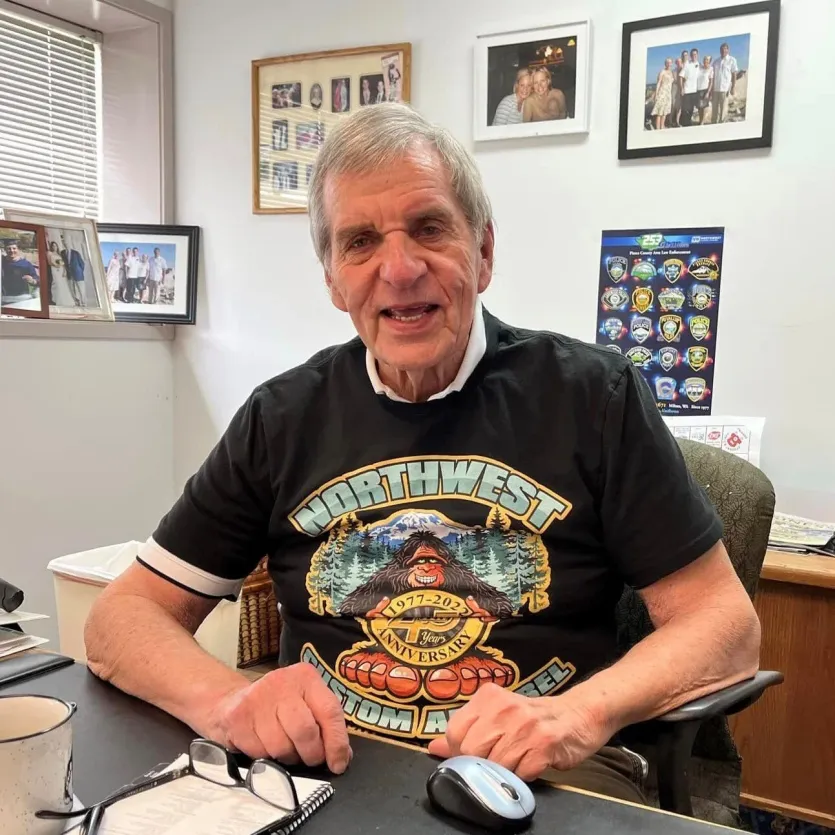
This article revisits the pioneering days of Northwest Custom Apparel (formerly Northwest Embroidery) to show how far the industry has come. Jim Mickelson, our founder, reflects on our 48 years in business, providing authentic insights into how technology and market needs have evolved. This history establishes our experience and authority in the custom embroidery and apparel space.
1985: The Start of a Legacy
In 1985, Northwest Custom Apparel installed the first cap embroidery machines in the Pacific Northwest. That technology required intense manual labor and ingenuity:
1985 Operational Reality
Modern Comparison
Digitizing: We called it “punching“ the designs. Operators devised long jump stitches to minimize thread jumps, which were then trimmed by hand.
Today, Digitized Embroidery software automatically optimizes designs and thread paths, creating precise, high-density files with minimal jumps.
Trimming: There were no automatic trimmers. Operators had to trim all caps using small embroidery scissors by hand.
Modern high-speed embroidery machines use automated trimming systems, ensuring clean finishes and consistency at production speed.
Communication: Business relied on telexes. Purchasing a fax machine was a major competitive advantage, allowing us to transmit an 8×11 sheet of information to Taiwan for emblem orders.
Now, orders are processed and coordinated globally using high-speed internet and cloud-based systems. Turnaround happens in days, not weeks.
The Economic Shift: Prices and Value
Newspaper Advertisement of Embroidered Polo Shirts and Caps from 1985
Comparing pricing from 1985 to today describes the huge changes in labor costs, material sourcing, and production efficiency. The old prices serve as a benchmark for the value we deliver now.
Polo Shirts: A good quality polo shirt sold for $7.50 each, including embroidery. The blank shirt cost us $4.75.
Caps: We sold embroidered caps for $4.00 each. A screen-printed cap cost the customer about $1.25 retail. The same cap sells for over $20.00 today.
Labor Cost: With the minimum wage at $3.35 an hour, an operator producing 24 pieces per hour meant our cost for embroidery was only 14 cents per piece. We could import caps for 95 cents each.
The low costs of 1985 let us compete directly with Asian manufacturers. This efficiency was possible then through incredibly low labor costs and basic technology. Today, modern embroidery machinery and advanced logistics allow us to adapt and change in a dynamic environment, prioritizing quality and speed over minimal price points.
A Story of Adaptability
Jim Mickelson has owned Northwest Custom Apparel since 1977. Reaching 48 years in business proves our sustained commitment to the custom apparel industry. This longevity, backed by real-world history, is the true foundation of our Authority and Trust. The shift from manual trimming and fax machines to modern digitization and high-speed production reflects our constant adaptation, ensuring we always deliver quality results today.
Jim Mickelson sits behinds his desk and reflects on his 48 years in the embroidery industry. Jim Mickelson, Owner of Northwest Custom Apparel since 1977
Erik Mickelson
Erik Mickelson is the author of the Northwest Custom Apparel blog and a veteran of the custom apparel industry. With over 29 years of experience since graduating from Washington State University in 1996, Erik brings a wealth of knowledge to every post. He is also the founder of the Apparel Graphic Academy, an expert credential that highlights his deep expertise.