
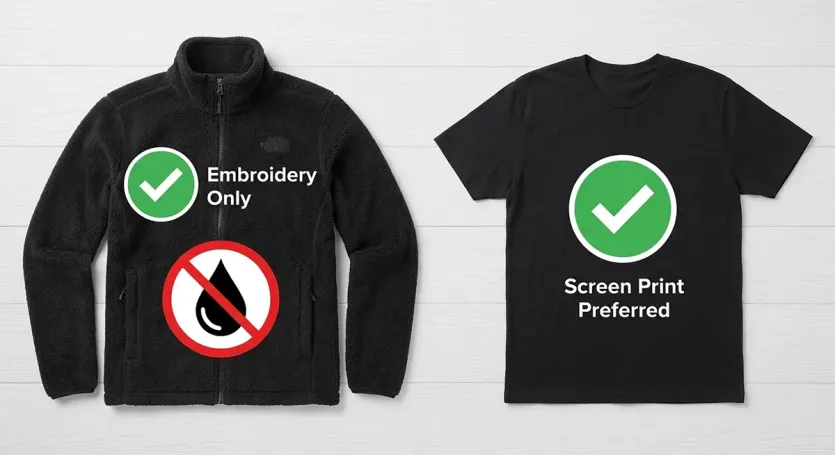
The best decoration method for work uniform depends on three things: what garment, what job role, and how the uniform gets washed. Neither method wins universally.
Embroidery is stitched thread that becomes part of the garment structure. It survives repeated commercial laundering, resists abrasion from tool belts and seat harnesses, and communicates professionalism on client-facing staff. Screen printing is ink applied to the fabric surface. It costs less per piece at bulk quantities, handles large colorful designs, and is the only decoration method certified for Hi-Vis safety apparel under ANSI/ISEA 107-2015.
This article gives you the specific answer for each uniform situation — by garment, by industry, and by how your team washes their gear. Not a generic one.
Embroidery Or Screen Printing – When to Choose Each Method?
| Factor | Embroidery | Screen Printing |
|---|---|---|
| Minimum order (NW Custom Apparel) | 8 pieces | 48 pieces |
| Best garment types | Polo shirts, work jackets, caps, fleece | Cotton T-shirts, hoodies, Hi-Vis shirts |
| Design size limit | Best under 4″ × 4″ (left chest logo) | Up to 14″ × 18″ (full back prints) |
| Color count cost impact | None — up to 15 colors at same price | Increases per color screen added |
| Durability under commercial laundering | 100+ wash cycles, no cracking or fading | 25–50 wash cycles before visible degradation |
| Durability under home laundering | Outlasts the garment | Lasts effectively with proper care |
| Hi-Vis safety shirt suitability | No — voids ANSI certification | Yes — only certified method |
| Caps and hats | Yes — cylinder arm cap frame required | No — curved surfaces incompatible |
| Polar fleece and sherpa | Yes — only viable method | No — high-pile fabric incompatible |
| Reorder setup cost | None — design stored in machine memory | Reduced if screens retained |
How Embroidery Works on Work Uniforms and Why It Lasts
Embroidery stitches thread through the fabric and a stabilizer backing underneath it. The thread does not sit on top of the fabric, it passes through it and locks to the backing on the underside. That structural integration is the reason embroidered logos survive washing conditions that degrade screen-printed ink.
The process starts with logo digitizing. Your artwork file gets converted into a stitch file (DST, PES, or EMB format) that tells the embroidery machine exactly where to stitch, in what direction, and at what density. At NW Custom Apparel, we run a Tajima TMAR-KC 8-head machine at 1,100 RPM with 15 needles per head. All thread colors load simultaneously and switch automatically without machine stoppage. The machine stores up to 650 designs in memory, which means your logo is ready to run on every reorder without re-digitizing.
Before any full production run on a first order, we sew a physical pre-production sample on the actual garment you ordered. You approve the sample before we touch the full batch. This step catches digitizing issues — thread density, font legibility, backing weight — before they become production problems.
For our custom embroidery services – machine specs, fabric compatibility, and stitch count guide, the Tajima handles everything from left-chest polo logos to 15,000-stitch construction jacket backs.
Embroidery Durability Under Commercial Laundering
This is the variable most buyers overlook, and it changes the entire cost-benefit analysis.
A polo shirt worn by a tech company account manager and washed at home on a gentle cycle behaves differently than the same shirt worn by a construction foreman and sent weekly to a commercial laundry service. Commercial laundering means hot water, industrial detergent, and high-heat industrial drying — conditions that stress-test every decoration method aggressively.
According to Alsco Uniforms, a uniform rental and laundering company with direct experience in commercial wash environments, embroidery threads withstand bleaching, industrial laundry cycles, and the physical abrasion of daily industrial work — which is why embroidery appears on military uniforms. Thread does not crack under hot water or high-heat drying the way plastisol ink does.
Under home laundering, both methods perform well with proper care. The durability gap opens significantly in commercial laundry environments, where screen-printed plastisol shows visible cracking between cycles 25 and 50, and embroidered thread holds edge definition through the full garment life.

Where Embroidery Has Limits on Uniforms
Embroidery is not the right answer for every garment. Lightweight fabrics under 5 oz. like thin athletic performance shirts, or moisture-wicking jerseys, are poor candidates for dense embroidery. Needle pressure on lightweight material causes puckering, which makes the logo look warped and uneven over time.
Large back designs above 14 inches wide become stiff and heavy when embroidered. Full-back embroidery on a T-shirt is technically possible but produces a garment that feels rigid across the upper back, not practical for daily work uniforms.
Script fonts and fine detail below 1/2-inch letter height become illegible when stitched. A logo with thin serif text, gradients, or photographic shading does not reproduce well in thread.
And on Hi-Vis safety shirts, embroidery hooping applies mechanical pressure to the retroreflective tape. That pressure risks damaging tape placement and voids ANSI certification on most Hi-Vis styles. Screen printing is the only certified decoration method on Hi-Vis safety apparel — and we cover that in detail below.
How Screen Printing Works on Work Uniforms and When It Wins
Screen printing pushes ink through a mesh stencil onto the fabric surface. One screen per color. Plastisol ink is the industry standard for uniform screen printing. It bonds to cotton fibers under heat cure and produces vivid, opaque color with excellent coverage on both light and dark garments.
Screen printing is the correct method when your order exceeds 24 pieces with a simple design of 6 or fewer colors, when the garment is a cotton T-shirt or hoodie, or when your uniform requirement includes Hi-Vis safety apparel that must maintain ANSI certification.
On dark garments, we apply an underbase — a white plastisol layer printed first — before the color layers go on. Without the underbase, dark fabric absorbs ink color and dulls the final output significantly. On garments with 50% or higher polyester content, we use low-bleed plastisol to prevent dye migration from the polyester fibers bleeding into the ink during heat cure.
For custom screen printing services for bulk Washington orders, our in-house facility handles plastisol, water-based, and discharge inks — no outsourcing, no middlemen.
Screen Printing on Hi-Vis Safety Uniforms – The Only Certified Option
Washington state construction crews, road workers, and utility teams operate under OSHA visibility requirements that reference ANSI/ISEA 107-2015 standards. That standard governs Class 2 and Class 3 high-visibility safety apparel — the orange and yellow vests, shirts, and jackets worn on job sites and roadways.
Embroidery hooping clamps and applies mechanical pressure to the garment during production. On Hi-Vis apparel, this pressure risks distorting or damaging the retroreflective tape placement that ANSI certification depends on. Screen printing applies ink to the background fabric areas only, without contact with the tape strips. For this reason, screen printing is the decoration method used on Hi-Vis safety stripe screen printing for ANSI-compliant Washington construction workwear.

The ANSI/ISEA 107-2015 standard (webstore.ansi.org) defines the retroreflective tape placement, background material requirements, and performance specifications that Class 2 and Class 3 garments must meet. Decoration that interferes with those specifications voids certification. If your crew works in traffic control, roadway construction, or utility maintenance in Washington state, screen printing on Hi-Vis is not optional — it is the compliant choice.
Where Screen Printing Has Limits on Uniforms
Each color screen carries a setup cost. A 7-color logo on a black shirt requires 8 screens, 7 colors plus a white underbase. That setup cost is significant on orders under 100 pieces and makes complex multicolor designs expensive at low quantities.
Screen printing cannot be applied to caps and hats. The curved, structured surface of a baseball cap makes mesh screen contact impossible. Embroidery with a cylinder arm cap frame is the only practical method on headwear.
High-pile fabrics like polar fleece and sherpa cannot be screen printed. The uneven surface prevents clean ink transfer and produces blurry, inconsistent output. Embroidery is the only viable decoration method on these substrates.
And under commercial laundering over a 12 to 24-month uniform lifespan, screen-printed plastisol ink degrades faster than embroidered thread. For uniform programs where garments get washed weekly in commercial machines, this difference shows up in the total cost of uniform replacement over time.
Durability Compared – How Each Method Holds Up Over a Full Uniform Lifespan
Which lasts longer, embroidery or screen printing? Embroidery outlasts screen printing in commercial laundering environments. Under home laundering with proper care, both methods perform well for the full garment lifespan.
That laundering environment qualifier matters more than any other variable in this comparison. Buyers who skip it end up replacing uniforms on a faster cycle than they budgeted for.
The Laundering Environment Distinction
Under commercial laundering — hot water, industrial detergent, high-heat industrial drying, weekly frequency — screen-printed plastisol on cotton begins showing visible cracking between wash cycles 25 and 50. Embroidered thread on the same garment holds color, edge definition, and tactile quality through the full garment life. In many cases, the thread outlasts the garment itself.
Under home laundering on a normal cycle, quality screen printing on quality blank garments performs effectively for typical apparel lifespans. The degradation curve is much slower. Event T-shirts worn occasionally stay vibrant for years. Daily-wear polo shirts maintain appearance through normal washing with proper care.
The practical implication: construction crews and tradespeople whose uniforms go through commercial laundry services should default to embroidery on work jackets and polo shirts wherever the garment allows it. Corporate office teams washing polo shirts at home have more flexibility – both methods perform acceptably at that wash frequency.
Teams who take uniforms home wash differently from a centrally laundered operation. If you cannot control washing behavior across your crew, choose the method that tolerates variation best for that garment type.
Care Recommendations That Extend Uniform Life
| Care Step | Embroidered Uniforms | Screen-Printed Uniforms |
|---|---|---|
| Wash temperature | Cold water | Cold water |
| Wash setting | Gentle or normal cycle | Gentle or normal cycle |
| Turn garment | Inside-out before washing | Inside-out before washing |
| Drying | Low heat or hang dry | Low heat or hang dry |
| Ironing | Avoid ironing directly over embroidery | Never iron directly over print |
| Bleach | Avoid chlorine bleach; color-safe only | Avoid bleach entirely |
| Dry cleaning | Safe for most embroidered garments | Not recommended |
Cost Comparison of Embroidery vs Screen Printing for Work Uniforms
Is embroidery more expensive than screen printing? At low quantities with a simple 1–3 color logo, embroidery and screen printing are comparably priced. At high quantities with a simple design, screen printing costs less per piece. But when the logo has many colors, embroidery often costs less per piece than screen printing, because embroidery cost does not increase with color count.
The Color Count Advantage of Embroidery
Embroidery pricing has two components: a one-time digitizing fee (typically $20–$60 per design, paid once) and a per-piece cost based on stitch count — priced at $1–$3 per 1,000 stitches according to industry data from Scalable Press (2024) and Magnetic Hoop (2025). The number of colors in your logo has no impact on the per-piece cost.
The Tajima TMAR-KC carries 15 needles per head with automatic color change. All thread colors load simultaneously at the start of the run. A 7-color embroidered logo costs the same to produce per piece as a 3-color embroidered logo at the same stitch count. For our logo embroidery for Washington corporate and workwear uniform programs, this pricing structure makes embroidery the more economical choice for multicolor logos that would require 5+ screens in screen printing.
Screen printing charges one setup fee per color screen. A 7-color design on a black shirt requires 8 screens, 7 colors plus white underbase. At a typical $10–$25 per screen setup cost, that is $80–$200 in setup before a single shirt runs. On orders of 200+ pieces, that setup cost spreads thin. On orders of 24 to 48 pieces, it adds significant per-unit cost.
Reorder Economics for Ongoing Uniform Programs
Once a logo is digitized, the stitch file lives in the Tajima TMAR-KC’s 650-design memory. Reorders run immediately. No re-digitizing fee, no artwork retrieval delay – your logo is queued and ready.
Screen printing reorders require screen retrieval and re-registration. If screens are retained from the original order, setup cost is reduced. If they were not retained, full setup applies again. For Washington businesses running quarterly or annual uniform reorders — new hire onboarding, seasonal staff expansion, garment replacement — the embroidery reorder cost advantage compounds meaningfully over a 2–3 year uniform program.
The NW Custom Apparel Uniform Method Selection Guide by Industry and Job Role
No other decorator in Washington state publishes a decision guide at this level of specificity. This table gives you the recommended decoration method for your industry, your job role, and your specific garment, with the reason behind each recommendation.
| Industry | Job Role | Garment | Method | Reason |
|---|---|---|---|---|
| Construction / trades | Field crew | 12 oz. duck canvas work jacket | Embroidery | Heavy fabric handles 15,000+ stitches; logo survives tool belt and surface abrasion |
| Construction / trades | Road crew / utility | Hi-Vis safety shirt | Screen printing | Only ANSI-certified method; embroidery hooping voids retroreflective tape certification |
| Corporate / professional services | Client-facing staff | Polo shirt | Embroidery | Professional appearance; 100+ wash cycles under home laundering; Pantone thread color matching |
| Corporate / professional services | All-hands events | Cotton T-shirt | Screen printing | Bold design at scale; lowest per-unit cost at 100+ pieces; event wear, not daily uniform |
| Healthcare | Clinical staff | Scrubs, tunics | Screen printing or small embroidery | Comfort and breathability priority; avoid heavy embroidery across upper back and shoulders |
| Healthcare | Reception / admin | Polo shirt | Embroidery | Client-facing; professional appearance; standard left-chest logo |
| Restaurant / hospitality | Front of house server | Polo shirt | Embroidery | Daily wear; frequent laundering; professional appearance for guest interaction |
| Restaurant / hospitality | Event or seasonal staff | T-shirt | Screen printing | Short-term wear; cost-effective for seasonal staff turnover |
| School / youth sports | Coaches, admin staff | Fleece jacket or hoodie | Embroidery | Polar fleece cannot be screen printed; embroidery is the only method on this substrate |
| School / youth sports | Student teams | Cotton hoodie or T-shirt | Screen printing | Bulk quantity; 2–4 color design; lowest per-unit cost at 48–200 pieces |
| Warehouse / logistics | Fulfillment, distribution | Cotton work shirt | Screen printing | Company name and employee ID at scale; simple design; 24+ pieces cost-effective |
| HVAC / maintenance | Field technicians | Work shirt or polo | Embroidery | Daily client contact; professional appearance; logo survives tool and equipment abrasion |
For custom embroidered work jackets for construction and trades crews, duck canvas outerwear from Dri Duck and CornerStone handles high stitch counts without puckering – built specifically for the PNW trades environment.
For school uniform and team apparel programs across Washington state, we run both embroidery and screen printing in-house, which means coaches jackets and bulk event T-shirts ship together from a single order.
Using Both Methods in the Same Uniform Program
Most Washington businesses with more than one crew type end up using both methods across a single uniform program. That is not a compromise but the correct strategy.
A concrete example: a commercial HVAC company with 40 field technicians and a 12-person office team. The field technicians wear embroidered polo shirts and embroidered work jackets for client site visits — durable, professional, survives the job site. The same company orders screen-printed cotton T-shirts for warehouse and loading staff — cost-effective at quantity, simple design, laundered in-house. Same logo. Same Pantone color references used for both thread matching and ink mixing. Consistent branding across both methods.
For businesses managing ongoing uniform programs with multiple departments and garment types, custom webstore programs for ongoing Washington business uniform programs handle self-ordering by department. Each employee selects their designated garment type and size. The decoration method is pre-assigned by role. Orders batch automatically and ship to a single address or individual addresses depending on your program setup.
The Printing United Alliance, the global trade association representing the printing and graphic arts industries, recommends that decoration method selection consider garment type, wash frequency, and intended use — exactly the logic behind a mixed-method program structured by job role rather than a single blanket choice across the entire workforce.
Fabric Compatibility – Which Garments Take Each Method
| Fabric / Garment Type | Embroidery | Screen Printing | Notes |
|---|---|---|---|
| 6–7 oz. pique polo shirt | ✓ Excellent | ✓ Acceptable | Cutaway backing required for embroidery on knit |
| 12 oz. cotton duck canvas work jacket | ✓ Excellent | ✗ Not practical | Best embroidery substrate for high stitch count |
| 100% cotton T-shirt | ✓ Left chest only | ✓ Excellent | Screen printing optimal for full-chest or back designs |
| 50/50 cotton-poly hoodie | ✓ Left chest | ✓ With low-bleed ink | Low-bleed plastisol required on poly content above 50% |
| Structured baseball cap | ✓ Required | ✗ Not compatible | Embroidery with cylinder arm cap frame; screen printing impossible |
| Hi-Vis safety shirt | ✗ Voids ANSI cert | ✓ Required | Embroidery hooping risks retroreflective tape damage |
| Polar fleece / sherpa | ✓ Only option | ✗ Not compatible | High-pile surface prevents clean ink transfer |
| Under 5 oz. athletic / moisture-wicking | ✗ Causes puckering | ✓ Acceptable | Avoid embroidery on lightweight stretch fabric |
| Waterproof / membrane fabric | ✗ Needle creates holes | ✓ Surface application | Embroidery needles perforate waterproof membranes |
| Denim work shirt | ✓ Excellent | ✓ Acceptable | Heavy fabric supports both; embroidery preferred for durability |
Frequently Asked Questions
Embroidery lasts longer in commercial laundering environments. Thread passes through the fabric and bonds to the backing underneath — it does not sit on the surface where friction and heat cause degradation. Under commercial laundering at weekly frequency, screen-printed plastisol ink shows visible cracking between cycles 25 and 50. Embroidered thread holds through 100+ cycles with no color loss or edge degradation. Under home laundering with proper care, quality screen printing on quality garments performs well for the full garment lifespan. The laundering environment is the key variable.
It depends on quantity and color count. At quantities above 100 pieces with a simple 1–3 color design, screen printing costs less per piece. At any quantity with a 5+ color logo, embroidery often costs the same or less — because embroidery cost does not increase with color count, while each additional color in screen printing adds a screen setup cost. A one-time digitizing fee of $20–$60 applies to the first embroidery order. Subsequent reorders carry no additional setup cost.
No. Embroidery hooping applies mechanical pressure to the garment during production. On Hi-Vis safety apparel, this pressure risks distorting or damaging the retroreflective tape placement that ANSI/ISEA 107-2015 certification requires. Screen printing applies ink only to background fabric areas without contact with the tape. For Washington crews operating under OSHA visibility requirements, screen printing is the compliant decoration method on Hi-Vis Class 2 and Class 3 garments.
Embroidery. Polo shirts are the primary embroidery substrate in professional uniform programs. The pique knit fabric supports cutaway backing, which stabilizes the stitch and prevents puckering. Left-chest logo placement at 3.5″–4″ wide is the standard for corporate and workwear polo shirts. Embroidery on polo shirts survives 100+ home laundering cycles and communicates a professional appearance that screen printing cannot replicate on this garment type.
Yes, and for most multi-role Washington businesses, this is the recommended approach. Embroidery on client-facing garments (polo shirts, work jackets), screen printing on high-quantity casual garments (T-shirts, event hoodies). Same logo, same Pantone color references for both thread matching and ink mixing. Our custom webstore programs handle self-ordering by role, with decoration method pre-assigned by department.
Wash temperature and drying heat are the two most damaging variables for screen printing. Hot water softens and expands plastisol ink; high-heat drying stresses the ink layer at bend points, accelerating cracking. Cold water, gentle cycle, and low-heat drying extend screen-printed uniform life significantly. Embroidered uniforms tolerate washing variation better (thread does not crack under heat) but high-heat drying over extended time periods can cause thread shrinkage and fabric distortion. Both methods benefit from inside-out washing and avoiding direct ironing over the decorated area.
At NW Custom Apparel, the minimum order for embroidery is 8 pieces per design. The minimum for screen printing is 48 pieces per design. DTG (direct to garment) printing carries 12 pcs minimum and suits single-piece or very small orders with small batch fee of $50. For stitch count guidance that affects per-piece embroidery cost, see our embroidery stitch count guide for logos.
No. Embroidery cost is based on stitch count, not color count. The Tajima TMAR-KC carries 15 needles per head and switches thread colors automatically without stopping the machine. A 7-color embroidered logo costs the same per piece as a 3-color logo at the same stitch count. This is a significant cost advantage over screen printing, where each additional color requires an additional screen with its own setup cost.
Get the Right Method for Your Uniform Program
Not sure which method fits your Washington team? Tell us your garment type, how your crew washes their uniforms, and your quantity. We recommend the right method and turn around a quote within one business day.
Request a quote for your uniform program →
Or explore the specific services most relevant to your industry:


