
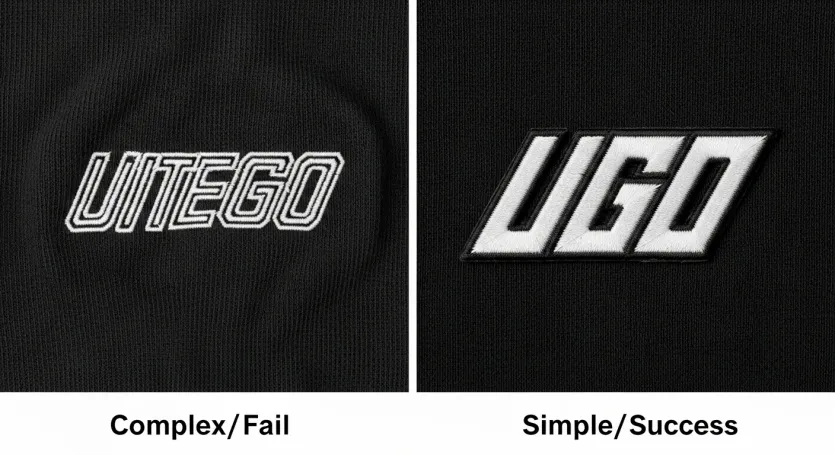
The Patch Is the Ultimate Test for Any Logo
A billboard hides flaws. A website header crops them out. A business card reduces them to insignificance. But a 3-inch embroidered patch exposes every weakness in your logo design. Thin lines become thread blobs. Complex gradients become solid color blocks. Detailed illustrations become unrecognizable shapes.
At Northwest Custom Apparel in Milton, Washington, we have produced custom embroidered patches for Boeing, military units, restaurants, and construction companies since 1977. We have embroidered patches on twill, leather, and PVC. We have sewn them onto jackets, caps, bags, and uniforms. We know which logos survive the patch test and which ones fail.
This article covers three design principles that determine whether your logo works on a patch. Not general branding advice. Specific guidance from our production floor.
1. Simplicity: The Only Option at Small Scale
Why Complexity Dies on a Patch
Our Tajima TMAR-KC embroidery machine uses needles that are 0.3 millimeters wide. Thread is thicker than a pixel. A line that looks crisp on a screen at 300 DPI becomes a single stitch on fabric. If that line is too thin, the needle cannot follow it accurately. The result is a fuzzy, indistinct shape.
We see this most often with logos that include:

- Fine geometric patterns that merge when reduced to patch size
- Photographic detail or realistic shading that embroidery cannot reproduce
- Multiple overlapping elements that create dense stitch clusters
The Boeing 787 patch we produced is a good example. The original logo included detailed aircraft contours and gradient sky elements. For the patch, we simplified to a clean silhouette, bold text, and two thread colors. The patch is readable from 10 feet. The original design would have been a gray smudge.
How to Simplify for Patches
Start with your existing logo. Reduce it to 3 inches wide on your screen. Remove every element that is not essential to recognition. If your logo includes a tagline, remove it. If it includes a founding date, remove it. If it includes decorative flourishes, remove them.
What remains should be:
- One central shape or icon
- Your company name or initials
- No more than two or three colors
If what remains is not recognizable, your logo is too complex for patch embroidery. Consider a simplified secondary mark specifically for small-format applications.
Stitch Density and Fabric Distortion
High stitch density pulls fabric inward. On a small patch, this can warp the shape and cause puckering around the edges. We control this with proper digitizing and stabilizer backing, but a simpler design makes our job easier and your patch flatter.
A logo with 15,000 stitches on a 3-inch patch requires heavy stabilizer and careful tension control. A logo with 8,000 stitches on the same patch sews cleanly with standard backing. The simpler logo costs less to produce, lasts longer, and looks better.
Understanding the production process helps explain why simplicity matters. Our article on how custom patches are made walks through digitizing, hooping, stitching, and finishing from our production floor in Milton, WA. When you see how thread behaves on fabric, the case for bold shapes and open space becomes clear.
2. Continuity: One Logo, Every Application
Why Consistency Matters for Production
We produced patches for the Happy Ending Bar and Restaurant in Tacoma. The logo was consistent across their website, signage, and apparel. We used the exact same vector file for the embroidered patch, the screen-printed t-shirts, and the embroidered aprons. Every piece matched.

This consistency is not just branding. It is production efficiency. When a client uses the same approved file for every order, we store the digitized stitch file and the screen separations. Reorders ship faster because the setup work is already done. New garments match old garments because the source file never changed.
The Cost of Inconsistency
We have seen clients bring us a logo from their website, a different version from their business cards, and a third version from a flyer. Each version has slightly different proportions, colors, or text placement. We must choose one version or recreate the others. This adds cost, delays production, and risks inconsistency in the final apparel.
Before you order patches, consolidate your logo files. Choose one vector version (AI or EPS) as the master file. Use it for every application. Send us that file. We will adapt it for embroidery, screen printing, or DTG without altering the core design.
Vector Format Is Non-Negotiable
Pixel-based files (JPEG, PNG) cannot scale for patch production. They also cannot be digitized for embroidery. We require vector files for all patch orders. If your logo exists only as a raster image, our custom artwork and graphic design services can recreate it as a vector file with full ownership transferred to you.
For more on file format requirements and technical specs, see our technical logo design rules for embroidery and printing.
Typography: Fonts That Survive the Needle
The Physical Limits of Thread

Thread is not ink. It has thickness, texture, and sheen. A font that looks elegant on paper can become illegible when stitched. Thin serifs disappear. Script connections merge into solid blocks. Decorative flourishes become indistinct loops.
We produced patches for ACO 2-3 AVN, an aviation unit. Their patch required clear, readable text at 2 inches wide. We used a bold sans-serif font with consistent stroke weight. The text is readable from a distance. A script or serif font at the same size would have been a thread tangle.
Font Rules for Patch Embroidery
| Font Characteristic | Recommendation | Why |
|---|---|---|
| Stroke weight | Bold, consistent thickness | Thin strokes cannot be stitched cleanly |
| Serif style | Avoid or use slab serifs only | Fine serifs merge with fabric texture |
| Script fonts | Avoid for small patches | Connecting lines break or blob |
| Letter spacing | Moderate to wide | Tight spacing causes letters to merge |
| Text height | Minimum 0.25 inches (6.4 mm) | Smaller text becomes illegible |
When Text Replaces Icons
Some logos rely on text alone. This works well for patches if the text is bold and brief. A three-letter abbreviation (like ACO) stitches cleanly and reads instantly. A full company name with 15 letters becomes a horizontal blur on a circular patch.
If your logo is text-heavy, consider creating an abbreviated version for patches. Use initials instead of full words. Remove articles and prepositions. “Northwest Custom Apparel” becomes “NWCA.” “Happy Ending Bar and Restaurant” becomes “HEBR.” The abbreviation becomes your patch mark.
Patch Types and Applications
Embroidered Patches on Twill
The most common patch type we produce. Twill backing provides a stable base for dense stitching. Merrowed edges (overlock stitching around the border) create a clean, finished look. Sew-on or iron-on backing options for easy application.
Best for: Uniforms, jackets, bags, team apparel.
For businesses that need patches for uniforms, team apparel, or promotional items, our custom patch services include design consultation, digitizing, production, and finishing. We handle sew-on, iron-on, and Velcro backing options. Every patch runs through our Tajima embroidery machines in Milton, WA.
Leather and PVC Patches
For premium applications, we produce patches on leather or molded PVC. Leather patches work well for outdoor brands, breweries, and rustic aesthetics. PVC patches are waterproof and durable, popular for tactical and military use.
These patches require different design constraints. Leather patches use debossing or laser engraving instead of thread. PVC patches use molded color layers instead of stitching. The same simplicity principles apply, but the production method changes the design rules.
Direct Embroidery vs. Patch Application
Some clients ask whether to embroider directly onto the garment or to sew a patch onto it. Direct embroidery is permanent and integrated into the fabric. Patches are removable and replaceable.
We recommend patches when:
- The logo changes frequently (annual updates, rotating sponsors)
- The garment is expensive and the logo might need removal later
- Multiple logos must appear on the same garment
We recommend direct embroidery when:
- The logo is permanent and unlikely to change
- The garment is standard workwear with a long replacement cycle
- A seamless, integrated look is preferred
Frequently Asked Questions
We can produce patches as small as 1.5 inches, but 2.5 to 3 inches is the practical minimum for most logos. Below 2 inches, text becomes unreadable and detail disappears. If you need a smaller application, consider direct embroidery instead of a patch.
We recommend 1 to 3 thread colors for standard patches. Each additional color requires a thread change, which increases production time and cost. Four colors are possible. Five or more colors become impractical for small patches and rarely improve recognition.
No. Embroidery cannot reproduce photographic detail, gradients, or subtle shading. Photographs must be simplified to line art or converted to a woven patch process (which we do not offer in-house). For photo-realistic images on apparel, direct-to-garment printing is the correct method.
Vector files in AI, EPS, or PDF format. We cannot work from JPEGs, PNGs, or scanned images. If you do not have a vector file, our logo digitizing service converts your artwork into a production-ready stitch file.
Standard turnaround is 10 business days for embroidered patches. Rush orders are available for 5-day turnaround when our schedule allows. Leather and PVC patches require 2 to 3 weeks due to material sourcing and specialized production.
Ready to Design a Logo for Patches?
We have produced custom patches for Washington businesses since 1977. Every patch runs through our Tajima embroidery machines in Milton, WA. We digitize, stitch, finish, and ship in-house.
We have produced embroidered patches for Tacoma businesses, military units, and organizations across Pierce County since 1977. Local pickup is available for Tacoma and Seattle clients. Shipping is available nationwide.
Send us your logo for a free patch feasibility review:
Email: sales@nwcustomapparel.com
Call: 253-922-5793
Visit: 2025 Freeman Rd E, Milton, WA 98354
Or start a new logo design project with patches in mind:
Request a Patch Design and Production Quote →
For guidance on choosing the right logo type for your business, see our article on how to choose a company logo for apparel.
About the Author
Erik Mickelson is the Operations Manager at Northwest Custom Apparel in Milton, Washington, with 29 years of hands-on experience in embroidery digitizing, screen printing, and custom apparel production. He graduated from Washington State University in 1996 and founded the Apparel Graphic Academy. His father, Jim Mickelson, founded Northwest Custom Apparel in 1977.


