

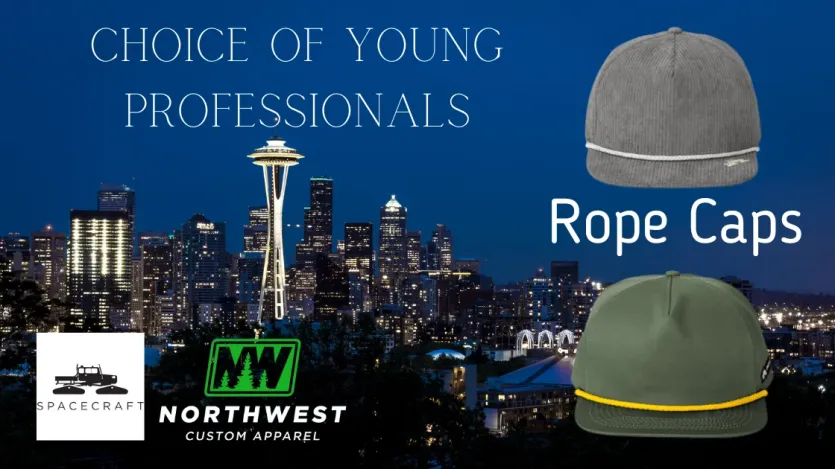
Rope caps are a good pick when you want branded headwear with a more distinctive look than a standard baseball cap or trucker hat. They work well for golf outings, corporate events, teams and outdoor brands.
A rope cap stands out on a shelf and on a head. The braided cord across the front panel gives it a retro, golf-inspired look that a plain trucker hat does not have. That makes it a smart pick when you want your logo on something people will actually wear again.
Northwest Custom Apparel embroiders rope caps in-house at our Milton, WA facility. See part of our custom embroidered caps lineup. Below, we cover what a rope cap is, which construction fits your use case, and how to get your logo embroidered cleanly on the front panel.
Not sure a rope cap fits your brand? Get a Custom Rope Cap Quote and we will help you choose.
What Is a Custom Rope Cap?
A rope cap is a hat with a braided rope, or cord, stitched across the seam of the front panel. Builders offer it in several constructions, so “rope cap” describes a style family rather than one single hat.
The rope detail and front-panel construction
Most rope caps use a five-panel or six-panel crown with an unstructured or structured front panel. The rope sits along the seam where the crown meets the visor, and it comes in one or two colors. Closures are usually snapback or adjustable strap, which keeps sizing simple for bulk orders.

Because the rope sits close to the embroidery area, your logo placement may need to shift slightly. We will walk you through that when we review your proof, so the design clears the rope and follows the panel shape.
Why the style stands out
A rope cap reads as more premium and more lifestyle-driven than a flat-brim trucker hat. It carries a golf and outdoor heritage look, which makes it feel less “uniform” and more like something a person would choose to wear on their own. For a brand or event logo, that extra wear time is worth more than the cap itself.
Is a Rope Cap Right for Your Brand, Team or Event?
This is the real question before you pick a style. Rope caps work best in three situations.
Business and corporate branding
If you want corporate apparel and uniform programs that feel less “issued” and more like something employees choose to wear, a rope cap is a strong option. It works well for client gifts, company stores and casual-Friday branding where you want the logo to read as lifestyle, not uniform.
Golf tournaments and outdoor events
Rope caps have deep roots in golf and outdoor apparel, so the style already fits the setting. A performance rope cap in moisture-wicking fabric holds up on the course and still looks sharp when the round is over.
Teams, clubs and promotional campaigns
Teams and clubs use rope caps to give merchandise a distinct look that sets it apart from a standard custom sports team uniforms cap. That distinctiveness matters most for booster sales, fan gear and fundraiser items people buy because they like how it looks, not because they have to wear it.
Which rope cap fits your use?
| If you need… | Consider… |
|---|---|
| Golf or outdoor event appearance | Performance rope cap |
| Strong, consistent logo presence | Structured rope cap |
| Casual, lifestyle look | Unstructured rope cap |
| Extended outdoor wear | Performance or breathable fabric |
| Distinctive branded merchandise | Contrasting rope color with matched thread |
Which Rope Cap Construction Should You Choose?
Once you know the use case, the construction decision gets easier.
Structured rope caps for stronger branding
A structured crown holds its shape and gives your logo a stable, flat surface. This is the safer pick for a corporate logo, a wordmark, or any design where straight lines and clean edges matter.
Performance rope caps for golf and outdoor use
Performance builds use lightweight, breathable fabric designed for a full day outside. These fit golf tournaments, fishing trips and outdoor brand merchandise where comfort matters as much as looks.
Rope truckers and relaxed styles
A rope trucker pairs a foam or mesh back panel with the rope-and-rope front. It reads more casual and works well for retail drops, outdoor brands and events where a relaxed look fits the audience better than a structured cap.
Apart from rope caps, we have the alternative choice of Richardson 112 hat customization page.
The 5-Panel Advantage: A Better Canvas for Brand Logos
Marketing directors choose rope hats primarily for the branding real estate. The five-panel build offers a technical advantage over the six-panel alternative. In a six-panel cap, a vertical seam runs directly down the center of the forehead. This seam creates a physical “bump” that can distort fine details in an embroidered logo or cause registration issues during screen printing.
Because the rope cap uses a seamless front panel, it provides an unbroken canvas. This allows for larger, more intricate embroidery designs that would be impossible to execute cleanly over a seam. The lack of a center stitch line means your logo sits flat and remains legible from a distance.
Engineering standards for performance headwear emphasize the dimensional stability of the five-panel crown, which avoids the structural tension found in traditional center-seam designs.

The continuous front panel can provide a clean embroidery area on styles designed without a center seam.
What Decoration Works Best on Rope Caps?
The front panel on a rope cap is smaller than a standard trucker hat panel, so decoration choice matters.
Flat embroidery for detailed logos
Flat embroidery is the standard choice for wordmarks, small text and detailed logos. It sits close to the fabric, so it holds up on a smaller panel without the design feeling cramped.

3D puff for bold designs
3D puff raises the stitching for a bold, dimensional look, which works best on simple shapes and block letters. Read our full 3D puff embroidery on hats guide before you choose puff for a detailed logo, since fine lines do not translate well to raised stitching.
If your design has a high stitch count or a lot of small detail, check our embroidery stitch count guide first. Dense designs can affect both cost and how clean the final logo looks on a smaller panel.
When patches may make more sense
If your logo has more than three colors or fine photographic detail, a woven or embroidered patch applied to the front panel may look cleaner than direct embroidery. Our custom embroidered patches page covers when a patch outperforms direct stitching.
How Should You Match the Rope and Logo Colors?
Color pairing is where a rope cap goes from generic to genuinely branded.
Match the rope to your brand palette
Pick a rope color from your existing brand palette so the cap reads as an intentional part of your identity, not a random hat. A rope in your secondary brand color usually reads better than trying to match your primary color exactly, since exact color matching in cord is limited by supplier stock.
Use contrast for logo readability
Keep thread color high-contrast against the cap fabric so the logo stays legible from a distance. A dark cap with light thread, or the reverse, almost always reads better than a low-contrast pairing, even if the low-contrast option looks nicer up close.
How We Produce Custom Rope Caps in Washington
Every rope cap we embroider goes through the same in-house process, whether you order 8 caps or 500.
Choose the cap and decoration
Send your logo, quantity and preferred style if you have one. We recommend a construction and decoration method based on your design and how the caps will be used. You can also review our logo digitizing for embroidery guide if this is your first time ordering embroidered headwear.

Review the proof before production
You approve a physical, pre-production sample before we run the full order. This is the step that catches placement or color issues before they show up on 100 caps instead of one. Our full order process walks through each step from quote to delivery.
Production and delivery
Standard turnaround is 10 business days from sample approval, with rush service available at a 25% surcharge. Cap orders have a 24-piece minimum per style and color. We embroider every rope cap in-house at our Milton, WA facility, and 99.8% of our orders arrive on time.
Not sure which rope cap fits your logo? Send us your logo, quantity and deadline. We will help you choose a rope cap style and embroidery approach that fits how you plan to use it.
Frequently Asked Questions About Custom Rope Caps
A rope cap is a hat with a braided cord stitched across the front-panel seam. The rope gives it a retro, golf-inspired look that sets it apart from a standard baseball cap or trucker hat. Rope caps come in structured, unstructured and performance builds.
Yes, rope caps take both flat and 3D puff embroidery. The front panel is smaller than a standard cap panel, so logo placement may shift slightly to clear the rope. We confirm placement on your proof before production starts.
Yes, rope caps have strong roots in golf and outdoor apparel. A performance rope cap in breathable fabric holds up through a full round and still looks sharp afterward, which makes it a popular choice for tournament gifts and staff apparel.
A rope cap has a braided cord on the front panel, while a standard trucker hat does not. Some rope caps use a trucker-style mesh back, but the rope detail is what defines the style and gives it a more premium, lifestyle look.
Yes, but 3D puff works best on simple shapes and block letters. Fine detail and small text tend to look cleaner with flat embroidery. We can recommend the right method once we see your logo.
Yes, rope caps work well for corporate merchandise and client gifts. They read as lifestyle apparel rather than a uniform, which means employees and clients are more likely to wear them outside of work.
Keep your logo compact, since the front panel on a rope cap runs smaller than a standard cap panel. Simple wordmarks and icon-style logos embroider more cleanly than dense, detailed designs on this smaller space.
The minimum order is 8 caps per style and color. If you need fewer, contact us and we can discuss options, including combining rope caps with another style to meet minimums.
Standard turnaround is 10 business days from proof approval, with rush service available for a 25% surcharge. Sample turnaround before that runs 3 to 5 business days, so plan for that lead time when setting your order deadline.


