
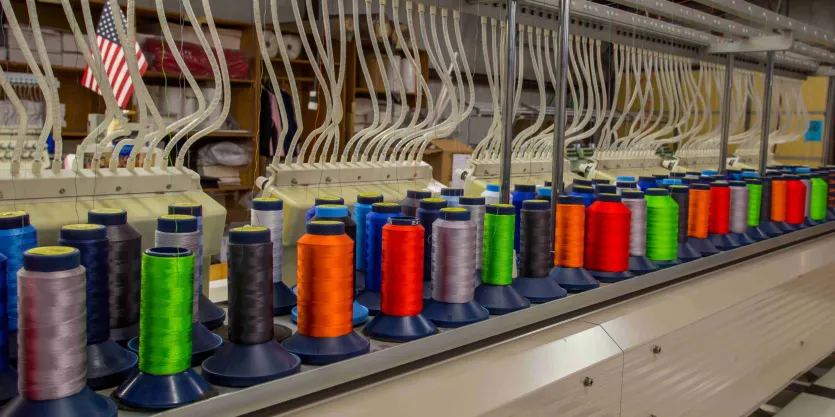
You are considering a custom embroidery order and you want to know if the vendor can actually deliver. Not whether they own a machine. Whether they own the right machines, run them at scale, and have the backup systems to handle your deadline. At Northwest Custom Apparel in Milton, Washington, we have produced commercial embroidery since 1977. This guide shows you exactly what equipment runs your order, why each piece matters, and what separates industrial production from hobby-grade work.
The Core Equipment: Tajima TMAR-KC Multi-Head Embroidery Machines
Our production floor runs Tajima TMAR-KC 8-head embroidery machines. Each machine has eight independent sewing heads, with 15 needles per head. That is 120 needles running simultaneously on a single design cycle.
What this means for your order:
- Speed: 1,100 RPM (revolutions per minute) per head. A left-chest logo on a polo shirt takes approximately 45 seconds to stitch.
- Consistency: All eight heads run the same digitized file simultaneously. A 500-piece uniform program produces identical logos across every garment.
- Color capacity: 15 needles per head means we can run designs with up to 15 thread colors without stopping to rethread. Complex logos with gradients, outlines, and fills stay in production without delay.
Why Tajima specifically: Tajima is the standard for commercial embroidery in North America. Their TMAR-KC series uses a reciprocating hook system that reduces thread breaks by 30% compared to rotary hook machines. Thread breaks stop production. Fewer breaks mean faster turnaround and cleaner finishes.
Hobby comparison: A desktop embroidery machine (the kind sold at craft stores) has one head, six needles, and runs at 400 RPM. It handles one shirt at a time. For a 500-piece order, that is 500 individual cycles. Our 8-head system completes the same order in 63 cycles. The difference is not incremental. It is the difference between a three-day turnaround and a three-week backlog.
Digitizing: The Software That Translates Your Logo Into Stitches
Before any machine runs, your artwork must become a digitized embroidery file. This is not a simple file conversion. It is a technical translation that tells the machine where to place each stitch, what angle to sew, how dense to pack the thread, and where to trim.
Our digitizing station runs:
- Wilcom EmbroideryStudio — industry-standard digitizing software used by Nike, Adidas, and major uniform manufacturers
- Pantone-matched thread libraries — we match your brand colors to exact thread shades, not approximations
- 3D simulation tools — we preview how the stitched logo will look on the actual garment before production starts
The process:
- File review. You send us your logo (AI, EPS, PDF, or high-resolution PNG). We evaluate whether the design is suitable for embroidery or if elements need simplification.
- Digitizing. Our art director, Steve Deland, converts the design into a DST or EMB file. This takes 30–90 minutes depending on complexity.
- Simulation. We run a 3D stitch simulation to check for thread breaks, puckering, or distortion on the specific fabric you selected.
- Sample approval. For orders over 100 pieces, we produce a physical sample on the actual garment for your approval.
- Production file lock. Once approved, the file is locked and stored for reorders. You never pay digitizing twice for the same design.
Why this matters: A poorly digitized file produces thread breaks, puckered fabric, and logos that look amateur. A properly digitized file produces clean edges, consistent density, and professional results that survive commercial laundering. Digitizing is 70% of embroidery quality. The machine is only 30%.
Explore our guide to Digitization Process From Vector File to Embroidery for more details.
Thread Systems: Why Color Accuracy and Inventory Matter
We maintain an inventory of 500+ thread colors from three manufacturers: Madeira, Isacord, and Gunold. Each brand has specific strengths:
| Thread Brand | Best For | Why We Stock It |
|---|---|---|
| Madeira | General commercial work | Broad color range, consistent dye lots, excellent wash durability |
| Isacord | High-detail logos | Trilobal polyester structure reflects light for sharper appearance |
| Gunold | Specialty applications | Metallic threads, fire-resistant threads, and neon safety colors |
Color matching process: We use Pantone bridge charts to match your brand colors to exact thread numbers. For corporate uniform programs, we keep your thread colors on file. Reorders are identical to the original run — no color drift, no guesswork.
Thread management: Our thread room is climate-controlled. Humidity causes thread swelling, which increases thread breaks. Temperature fluctuations degrade polyester strength. We maintain 45% relative humidity and 68°F year-round. This sounds excessive until you see the difference in production efficiency.
Stabilizers and Backing: The Invisible Structure
Stabilizers are the materials placed behind or inside the fabric during embroidery. They prevent puckering, support dense stitch counts, and ensure the logo stays flat after washing. The wrong stabilizer ruins an otherwise perfect design.
Our standard stabilizer types:
| Stabilizer Type | When We Use It | Why |
|---|---|---|
| Cut-away | Knits, polos, stretch fabrics | Permanent support; stays in the garment after stitching |
| Tear-away | Woven fabrics, caps, structured garments | Removed after stitching; cleaner interior finish |
| Water-soluble | Free-standing lace, appliqué, delicate fabrics | Dissolves in washing; no residual backing visible |
| Cap backing | Structured caps and hats | Rigid support for curved surfaces; prevents distortion |
The Cap Cylinder Challenge
Caps are not flat. They are curved, structured, and vary in crown height. We use Tajima cylinder frames that hold the cap in a curved position matching the machine’s sewing field. The frame rotates as the head stitches, maintaining consistent needle penetration angle across the entire design.
A flat hoop on a curved cap produces distorted logos. A cylinder frame produces logos that look correct from every angle. This is why cap embroidery costs more than flat garment embroidery — the setup is more complex, and the equipment is specialized.
Quality Control Systems: What Happens Before Your Order Leaves
Every piece is inspected at three stages:
Stage 1 – In-production monitoring: Operators check each head every 15 minutes for thread breaks, color shifts, and registration drift. Caught early, these are fixed in seconds. Caught late, they ruin the batch.
Stage 2 – Post-production inspection: Every finished garment is checked under LED lighting for thread tension consistency, trim quality, and logo placement accuracy. We measure placement against your approved spec sheet – typically ±2mm tolerance.
Stage 3 – Final pack-out: Garments are sorted by size, folded to prevent creasing across the logo, and packed with size labels visible. For uniform programs, we include packing lists by employee name and size.
What Equipment Does NOT Run Your Order
We do not use:
- Desktop embroidery machines (Brother PE800, Janome Memory Craft) – single-head, low speed, hobby-grade
- Generic digitizing software – auto-digitizing apps produce files with 40% more thread breaks than professional software
- Unmatched thread colors – “close enough” is not acceptable for brand standards
- Manual color changes – we program color sequences into the machine; operators do not hand-switch threads mid-run
If a vendor cannot tell you their machine model, their digitizing software, or their thread brand, they are not running commercial production. They are running hobby equipment and hoping for the best.
How This Equipment Translates to Your Timeline
| Order Size | Equipment Used | Typical Turnaround |
|---|---|---|
| 6–24 pieces | Single-head setup or 8-head with partial load | 3–5 business days |
| 25–100 pieces | Full 8-head production | 5–7 business days |
| 100–500 pieces | Multiple 8-head machines running simultaneously | 7–10 business days |
| 500+ pieces | Full floor production, dedicated operator assignment | 10–14 business days |
Rush production is available for deadline-driven orders. We maintain a priority queue for same-day and next-day turnaround when the schedule allows. Call 253-922-5793 to check current availability.
Ready to See the Equipment in Action?
You do not need to understand thread tension or reciprocating hooks to place an order. You need to know that the vendor has the equipment, the expertise, and the quality systems to deliver. At Northwest Custom Apparel, we have run commercial embroidery since 1977. Our facility is open for client visits by appointment. You can watch your logo being digitized, see the Tajima machines in production, and inspect finished samples before approving the full order.
Get a custom embroidery quote or call us at 253-922-5793. We will review your artwork, explain the production process, and give you a clear timeline with pricing. No guesswork. No hobby-grade results.
FAQs
Tajima multi-head industrial machines are the industry standard for commercial production. The TMAR-KC 8-head series runs at 1,100 RPM with 15 needles per head, producing consistent results at scale. Desktop machines are suitable for hobbyists but cannot handle business order volumes.
Turnaround depends on order size and design complexity. Small orders (6–24 pieces) typically require 2–3 business days. Large uniform programs (500+ pieces) require 7–10 business days. Rush production is available for deadline-driven orders.
Professional digitizing uses Wilcom EmbroideryStudio or similar industry-standard software. Auto-digitizing apps and consumer-grade programs produce files with higher thread break rates and inconsistent stitch quality. Commercial production requires professional digitizing.
Madeira, Isacord, and Gunold are the leading commercial thread manufacturers. Each offers specific advantages: Madeira for color range and durability, Isacord for high-detail sharpness, Gunold for specialty applications like metallics and safety colors.
Cut-away stabilizer stays in the garment permanently and is used for knits and stretch fabrics. Tear-away stabilizer is removed after stitching and is used for woven fabrics and structured garments. The wrong stabilizer causes puckering, distortion, or premature logo failure.
Yes. Northwest Custom Apparel welcomes client visits at our Milton, Washington facility by appointment. You can observe the digitizing process, see the Tajima machines in production, and inspect finished samples before approving your order.
About the Author
Erik Mickelson is the Operations Manager at Northwest Custom Apparel in Milton, Washington, with 29 years of hands-on experience in embroidery digitizing, screen printing, and custom apparel production. He graduated from Washington State University in 1996 and founded the Apparel Graphic Academy. His father, Jim Mickelson, founded Northwest Custom Apparel in 1977.


