
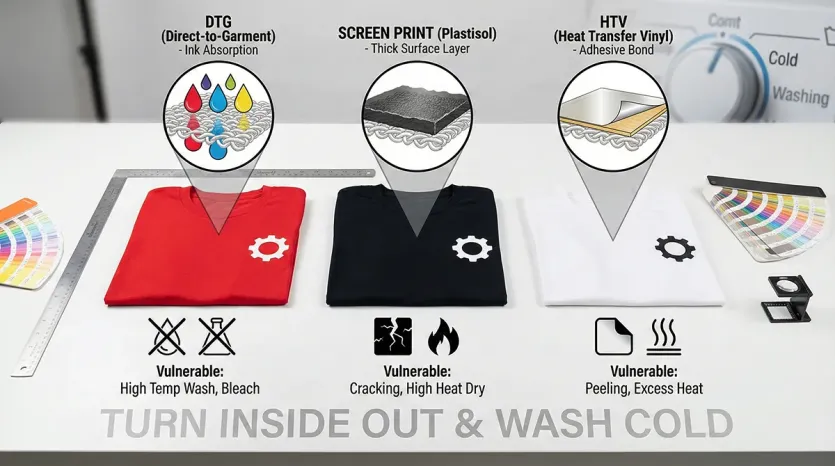
Printed garments are an investment, whether they represent a business, an event, or a favorite design. Preserving that print requires moving beyond generic laundry tips. The truth is, how you wash a shirt depends entirely on the printing method used—a fact that determines the specific chemicals and temperatures you must avoid.
Our expertise, built on decades of apparel printing, confirms that proper care starts with understanding the chemistry of the ink on the fabric. By following these protocols, you can significantly extend the life of your apparel, ensuring the print remains vibrant and intact for years.
The Chemistry of Durability: Why Care Differs by Print Method
Not all prints are created equal. The garment’s longevity is dictated by how the ink or material binds to the fabric fibers. Knowing the difference between the primary printing techniques allows you to select the correct care protocol, thus protecting your apparel investment.
DTG Printing & Water-Based Inks
Direct-to-Garment printing uses sophisticated water-based inks. These specialized pigments are sprayed directly onto the textile, much like an inkjet printer on paper.
- Mechanism: The ink is absorbed by the cotton fibers, creating a print that is incredibly detailed and feels soft to the touch. This soft “hand feel” is a major selling point.
- Pre-treatment: For the ink to bind permanently, especially on dark garments, a Pre-treatment solution is applied and cured with heat before printing. The long-term durability of a DTG print relies heavily on the integrity of this pre-treatment layer. Aggressive washing or harsh chemicals can weaken this structure, leading to fading or premature cracking.
- Best Fabric: This method works best on 100% ring-spun cotton because the fibers absorb the water-based ink most effectively.

Detailed, Durable, Direct-to-Garment Printing
Perfect for intricate designs, small-batch orders, and eye-catching colors. Make your brand vision a reality with DTG printing.
Get Custom DTG Printing SolutionScreen Printing & Plastisol Ink
Screen printing is a traditional, highly reliable method that uses Plastisol ink (a form of liquid plastic polymer).
- Mechanism: Unlike DTG, Plastisol ink does not soak into the fibers; it sits directly on top of the fabric surface, forming a dense, durable layer. This technique often produces a thicker, more tactile print.
- Durability: Screen prints are renowned for their longevity. If you require bulk orders for uniforms or high-wear items, The print can last for the entire life of the garment.
- Vulnerability: Because the print is essentially a plastic layer, it is most vulnerable to excessive heat, which can cause the layer to soften, crack, or peel over time.
Heat Transfer Vinyl (HTV) & DTF
Heat Transfer Vinyl (HTV) and its modern cousin, Direct-to-Film (DTF), use a thin film or cut-out material and a heat-sensitive adhesive to bind the design to the shirt.
- Mechanism: The design is transferred and fixed to the fabric using a high-pressure heat press. The bond is mechanical and highly susceptible to the same element that created it: heat.
- Vulnerability: HTV prints are most prone to edge lifting or peeling when subjected to high temperatures in a dryer or from direct ironing. The adhesive is the weak point in the care cycle.
The Universal Printed Garment Care Protocol
The following rules apply to virtually all printed apparel (DTG, Screen Print, and HTV) and serve as your foundational line of defense against premature wear.

Turn Garments Inside Out: Protecting Against Agitation
Before washing, always flip your apparel inside out. This simple action is one of the most effective strategies for preserving your print. When the garment is inside out, the design is protected from direct abrasion. This reduces the friction caused by the washing machine’s agitator and the rubbing against harsher items like zippers or buttons in the same load. Protecting the print from abrasion minimizes the risk of cracking, peeling, and pilling (small fuzzy balls) on the garment’s surface.
Wash Cold: Target 30°C (86°F) or Below
Cold water is essential for garment care. High heat is the primary catalyst for print degradation.
- Ink Integrity: Washing with hot water can cause the polymer structure in Plastisol to soften prematurely, accelerating cracking. For DTG, hot water can weaken the crucial bond established by the Pre-treatment, causing the ink to fade faster.
- Fabric Integrity: Cold water also helps maintain the original size and shape of the apparel, minimizing the fabric shrinkage that can cause prints to look warped or cracked. We recommend a setting of 30°C (86°F) or cooler for consistent results.
The shirt will retain its size, and the hot water will not damage the print. A good temperature is around 86°F (30°C) is generally safe, but cooler water is also acceptable.
The Absolute No-Nos: Avoid Fabric Softeners and Chlorine Bleach
Certain chemicals must be banned from your printed apparel laundry routine, especially when dealing with DTG.
- Fabric Softeners: Do not use liquid fabric softeners. These products deposit a cationic chemical residue on the garment fibers. This residue interferes directly with the chemical structure of water-based DTG inks, causing the print to dull, fade, and peel much quicker than normal.
- Chlorine Bleach: Chlorine bleach is highly caustic and acts as an abrasive, not only fading the garment’s dye but actively stripping and degrading the ink polymers, regardless of the printing method. If stain removal is necessary, use a mild, non-chlorine spot remover and apply it only to the unprinted fabric area.
Drying, Ironing, and Finishing: The Heat Equation
Heat is the single greatest enemy of all printed apparel. While water can gradually wear down a print, heat can damage it permanently in one cycle, leading to cracking, peeling, and garment shrinkage. Understanding the “heat equation” is paramount for long-term care.
Air Dry is King: The Best Practice

The most effective method for preserving any custom apparel print is to air dry the garment. Laying the shirt flat or hanging it to dry allows the fabric to return naturally to its original shape without exposure to abrasive heat.
Avoid Direct Sunlight: When air drying, hang your apparel in a place where it does not receive direct sunlight. Prolonged exposure to UV rays acts as a bleaching agent and can accelerate the fading of both the garment’s dye and the pigment in the print, especially for vibrant DTG prints and dark fabrics.
Tumble Dry ONLY on Low/No Heat

If you must use a machine dryer for convenience, use the lowest possible heat setting or select the air fluff/no heat cycle.
The Risk of High Heat: High temperatures can cause the Plastisol ink on a screen-printed shirt to become brittle and crack. More critically, high heat can cause the adhesive layer of HTV or DTF prints to soften and become sticky, potentially causing the print to adhere to itself when crumpled, leading to immediate peeling. Minimize dryer time and remove the garment immediately once dry.
Ironing Protocols: Protecting the Decoration
Ironing is rarely required for modern printed shirts, but if you need to remove wrinkles, follow a clear protective procedure:
- Turn Inside-Out: Always iron the garment inside out. This places the thick fabric layer between the hot iron plate and the print.
- Use Low Heat: Set the iron to the lowest temperature setting, typically designated for synthetics or nylon. Avoid using the steam setting, as the moisture and heat combination is particularly harsh on the print’s binding agents.
- Do Not Iron Directly on the Print: If the print area must be smoothed, use a pressing cloth (a thin cotton towel or sheet) placed over the print before applying the iron.
The Northwest Quality Foundation: Ensuring Longevity
The care of a printed garment is a partnership. While the consumer handles post-purchase washing, the print’s initial quality is set in the production studio. At Northwest Custom Apparel, we ensure the best possible start for your apparel’s durability by focusing on the materials and processes that build longevity. This commitment forms the core of our E-E-A-T.
- Garment Quality Matters: We select high-quality apparel, prioritizing ring-spun cotton for our DTG services. Ring-spun cotton fibers are smoother and denser, which allows for optimal absorption and adhesion of water-based inks, resulting in a crisper print that holds up better over time than standard carded cotton.
- Professional Curing and Pre-treatment: DTG prints require perfect heat curing and correct pre-treatment application. An improperly cured print will wash out quickly, regardless of how gently the consumer treats it. Our process guarantees that the ink is set permanently into the fibers, providing the maximum possible print life.
- Safety and Sustainability: We use OEKO-TEX® certified water-based inks. This certification confirms the inks are safe for adults and children, free of heavy metals and formaldehyde, and meet strict government standards. This choice means the apparel is not only durable but also responsibly produced.
Frequently Asked Questions (FAQs)
Wait a minimum of 24 hours, or preferably 72 hours, before the first wash. This allows the ink’s curing process to fully stabilize, maximizing the bond between the ink and the fabric fibers.
Screen printing with Plastisol ink is generally considered more durable for industrial use, usually lasting the life of the garment. However, a properly cured DTG print will maintain high quality for 50+ washes and provides a softer feel. For more details, explore the comparison between DTG vs Screen Printing.
Stiffness is usually caused by residue from the DTG pre-treatment agent. This residue is harmless and usually softens up completely after the first few washes.
Use stain removers sparingly and only on the unprinted fabric; never apply them directly to the print, as the harsh chemicals can strip the ink and destroy the graphic.


